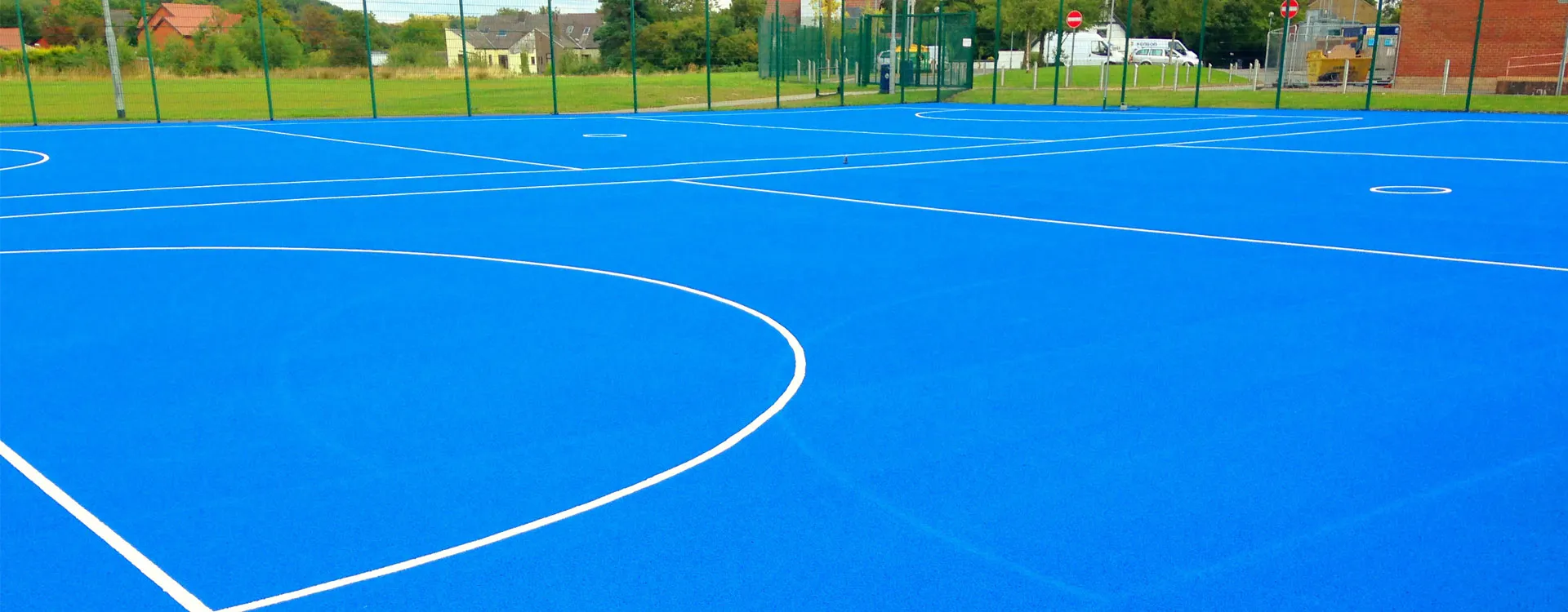
MUGA is an acronym for Multi Use Games Area, there are a wide range of different surface finishes and a variety of different sports and games that can be played.
Having the ability to play multiple sports in just one area comes with a great advantage foe schools and sports clubs so they can use each area to its full potential.
Although we are often asked the question ‘what is a MUGA?’, it is very difficult to answer this without finding more detail on the sports requirements. At Soft Surfaces, we pride ourselves on providing professional advice on the type of surface that would best suit your sports facility.
MUGA Explained
Please see a video below which explains what a MUGA is and how they are used in the UK to accommodate many different sports.
Please see transcript below:
00:00 Hi, guys. It’s Dan from Soft Surfaces here, and today I’m going to be talking about what is a multi-use games area.
00:05 A multi-use games area, otherwise known as a MUGA, is a multipurpose facility designed to incorporate sports such as tennis, netball, basketball, football, and many other sports all into one actual surface itself. It enables people to essentially play all of those sports at different times, or at the same time on one actual facility.
00:22 Great thing with multi-use games areas is that they’re available in various different surface types, including polymeric, tarmacadam and artificial grass. And these different surface types categorize into different types of MUGAs, so there’s a type one, a type two, etc, and we can really explain that in more detail in a whole other video.
00:38 On top of that, you can actually have specifications with completely different colors and schemes, you can have your logo applied to the multi-use games area, and have completely different colors for different sports, if that’s what you’re willing to do. They’re completely customisable and available in lots of bespoke options for your needs.
00:52 We have lots of experience, over 20 years, in fact, of installing these facilities, so we feel like we have the knowledge, the know-how of how to advise you into having the correct facility for what your needs are. If you need to know anything more about multi-use games areas or what we do, please just contact us at www.softsurfaces.co.uk.
What surface finishes can a MUGA have?
A MUGA can be finished in tarmacadam, 2G sand-filled turf, 3G artificial grass or polymeric rubber, and the finish decides which sports play best on it.
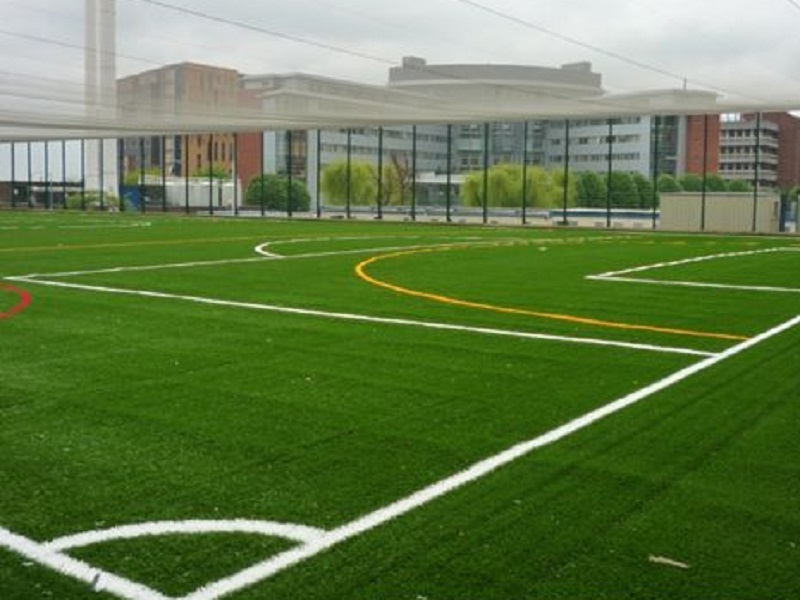
Multi use games area with synthetic turf
Here are some of the MUGA surface finishes that are possible:
- Tarmacadam is a hard tarmac surface ideal for basketball/netball, football (5 a-side), tennis or hockey where a ball has to be able to bounce or role on a flat surface.
- 2G is a compacted plastic pile filled with just sand. It provides a smooth flat surface for sports like hockey and football.
- 3G is a hard-wearing artificial grass that can have sand and rubber infill. These pitches are more useful for football and rugby. They can have shock absorbing properties to slide, fall and tackle on.
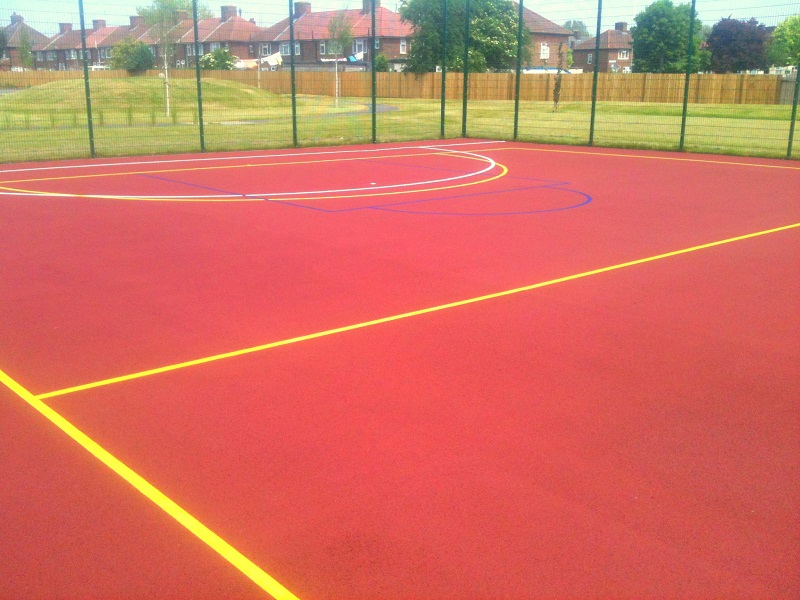
- Polymeric is a 10mm layer of rubber granules with an EPDM structural spray coat to provide anti-slip capabilities. This is laid over tarmac to give a hard rubber surface which is great for tennis, basketball and netball.
Each surface has different capabilities to provide a different finish for each designated sport or game.
What does MUGA stand for?
MUGA stands for Multi Use Games Area, a fenced outdoor court with an all-weather surface and several sets of coloured line markings, so that football, basketball, netball, tennis and hockey can all be played in one space. It is pronounced "mugger", which is why some schools ask for a "mugger pitch".
A MUGA is defined by three things: the surface (macadam, polymeric rubber or artificial grass), the line markings for each sport, and the equipment such as rebound fencing, recessed goals, basketball hoops and netball posts. Most are built for schools, colleges, councils and sports clubs that need more sport from less ground.
What sports can you play on a MUGA?
A MUGA can carry football, basketball, netball, tennis and hockey, plus PE lessons and playground games, because each sport gets its own set of line markings in a different colour on the same surface, and goals, hoops and posts are fitted around the court.
The surface decides which sports play best. A hard macadam or polymeric court suits ball-bounce sports such as basketball, netball and tennis, while a sand-filled or 3G artificial grass MUGA suits football and hockey. We mark out each court with anti-slip coloured coatings and sports line markings for the sports you choose.
What are the different types of MUGA?
The types of MUGA are graded by surface, from Type 1 and Type 2 macadam courts, through Type 3 and Type 4 polymeric rubber courts, to Type 5A sand-filled, Type 5B sand-dressed and Type 5C needlepunch synthetic surfaces, with 3G artificial grass MUGAs built for football.
| MUGA type | Surface finish | Primary sports |
|---|---|---|
| Type 1 and 2 | Macadam, with optional coloured anti-slip coating | Tennis, basketball, netball |
| Type 3 and 4 | Polymeric rubber | Netball, 5-a-side football, basketball |
| Type 5A | 2G sand-filled synthetic grass | Football, hockey |
| Type 5B | Sand-dressed synthetic grass | Hockey |
| Type 5C | Multisport needlepunch carpet | Football, hockey, athletics |
| 3G MUGA | Long-pile artificial grass with sand and rubber infill | Football, rugby |
If you are choosing between the two hard courts, our page on the difference between macadam and polymeric rubber compares them, and there is more on Type 3 polymeric MUGA surfacing.
How big is a MUGA?
A MUGA is usually around 38m by 18m or 35m by 17m, which fits a netball court of 30.5m by 15.25m, a basketball court of 28m by 15m or a 5-a-side football pitch inside the fence with room for safe run-off around the lines.
There is no single required size. A primary school MUGA is often smaller, while a two-court MUGA doubles the length so that two games run side by side. We set the size by the sports you want to mark and the space available, and explain the court dimensions on our pages for netball court MUGAs, 5-a-side MUGAs and outdoor basketball courts.
What is a MUGA at a school?
A MUGA at a school is a fenced, all-weather sports court in the school grounds that is used for PE lessons, break times, after-school clubs and inter-school fixtures, and is often let to community clubs in the evenings and at weekends to help cover its upkeep.
Because it drains and stays playable through winter, a school MUGA keeps PE outdoors when the playing field is too wet to use. Primary schools often add playground games and markings to the court, and secondary schools tend to choose a larger court or a 3G surface for football. See our ideas for MUGA pitch designs for primary schools and all-weather school MUGAs.
How much does a MUGA cost?
A MUGA costs from around £40 to £75 per square metre installed, and the average cost of a 2 court MUGA in the UK is around £130,000. These are indicative figures to confirm at survey, not fixed prices, because the surface, size, groundworks, fencing and floodlighting all change the total.
Macadam is usually the lowest-cost surface because it goes straight onto a compacted stone sub-base, while polymeric and artificial grass MUGAs cost more. Grants from bodies such as the Football Foundation and Sport England can help schools and clubs fund a new court. For a full breakdown, see MUGA pitch construction and costs and our MUGA construction specifications.
Does a MUGA need fencing, floodlights or planning permission?
A MUGA usually has rebound weldmesh fencing around the court to keep balls in play, and floodlights are optional for evening use; because the fencing is normally taller than 2m and floodlights affect neighbours, a new MUGA often needs planning permission from the local planning authority.
Planning rules depend on the site, so check with your local council early. We can supply the court layout, fence heights and floodlight details your application needs. There is more on fencing options on our sports fencing page.
How long does a MUGA last?
A well-built MUGA lasts around 8 to 15 years before it needs resurfacing, depending on the surface and how hard it is used: a synthetic grass carpet sits at the lower end, while a macadam or polymeric court lasts longer and can be cleaned and recoated to extend its life.
Regular brushing, keeping leaves and moss off, and a deep clean every year or two keep a MUGA draining and safe underfoot. We cover the routine on our MUGA pitch maintenance page, and fix worn or damaged courts through MUGA surfacing repair.
 3 Reasons to Build Dual Use MUGA Ball Court
 Building 5-a-Side Football MUGA in Gloucester
 Macadam MUGA Painting in Cheltenham, Gloucestershire
 Macadam Muga Painting in Taunton, Somerset
 MUGA Anti Slip Sports Coatings
 MUGA Construction Specifications and Costs
 MUGA Pitch Designs for Primary School
 MUGA Pitch Maintenance
- MUGA Surfacing Repair
Show all 22 related pages
 Needlepunch MUGA Surfacing Upgrade in London
 Polymeric MUGA in Cheltenham, Gloucestershire
 Polymeric MUGA in Haringey, London
 Polymeric MUGA in Kennington, London
 Polymeric MUGA Pitch Installation in Crawley, West Sussex
 Polymeric MUGA Pitch Resurfacing in Birmingham, West Midlands
- Pressure Cleaning Tennis Courts MUGA Surfaces
 School All Weather MUGA Pitches
 Size of 5 a Side Court MUGA
- Size of Netball Court Sports MUGAs
- Sports Fencing
 Type 3 Polymeric Surfacing MUGA
 What Is a MUGA?
For more information on MUGA’s for schools, colleges, sports clubs, leisure centres etc. please get in touch today and we can provide more information on the different type of surfaces.


